
To a first-time visitor, the walls of a Moroccan palace can look like pure decoration, a beautiful surface and nothing more. Look longer and something else appears. The patterns are not random. They are built on rules as exact as any equation, and they carry meaning that has accumulated over a thousand years.
Why geometry?
Islamic art largely turned away from depicting living figures in sacred spaces, and Moroccan artisans answered that by perfecting the abstract. Instead of portraits, they created infinity. Geometric patterns can repeat and extend in every direction without end, and that endlessness became a way to point toward the infinite and the divine, a reminder of something larger than the wall it covers.
Three great families of ornament grew up side by side in Morocco: geometric tilework (zellij), carved plaster (gebs), and carved cedar wood. Together they cover surfaces from floor to ceiling, each in its own register, in the madrasas and riads of Fes and beyond.
The language of the star
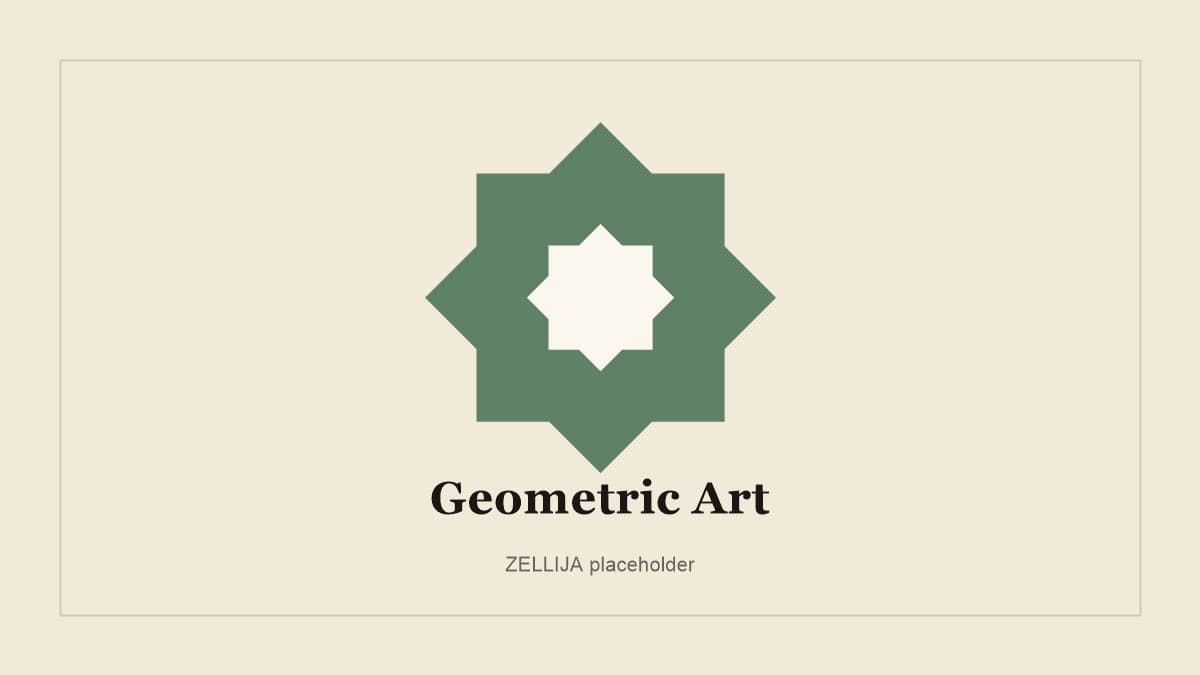
The eight-pointed star, often called the khatim or seal, is the signature motif of Moroccan zellij. It is built by overlaying two squares, one rotated against the other, and from that simple act an entire vocabulary unfolds. Stars with eight, twelve, sixteen, and many more points radiate outward, linked by ribbons and polygons into vast interlocking webs.
These are not drawn freehand. They begin from a circle divided into equal parts, and every line follows from that division. The result is a pattern that feels organic but is, underneath, pure mathematics. It is no accident that mathematicians and crystallographers study Moroccan tilework: it contains symmetries that Western science only formally described in modern times.
Color and its meaning
Traditional zellij draws on a specific palette derived from natural minerals. Cobalt blue, the famous Fassi blue, has long been associated with protection and the spiritual. Green carries connotations of paradise and life. White suggests purity, and the warm terracotta of the unglazed clay grounds the whole composition in the earth it came from. The palette is at once symbolic and practical, balancing harmony against contrast so the eye can rest and travel at the same time.
The endless knot
Beyond the stars run the interlacing bands, ribbons that weave over and under one another with no beginning and no end. This endlessness is the heart of the art's meaning. A pattern that never closes is a pattern that never stops, an image of continuity, of the eternal, of a unity that contains infinite variety.
Your name within the pattern
There is a long tradition in Moroccan art of weaving calligraphy into geometry, of letting the written word take its place among the stars. A personalized panel continues that idea in a personal key. Your name, set in Latin or in Arabic at the center of a field of hand-cut geometry, becomes part of a visual language that is centuries old, a small point of meaning held inside the infinite pattern.